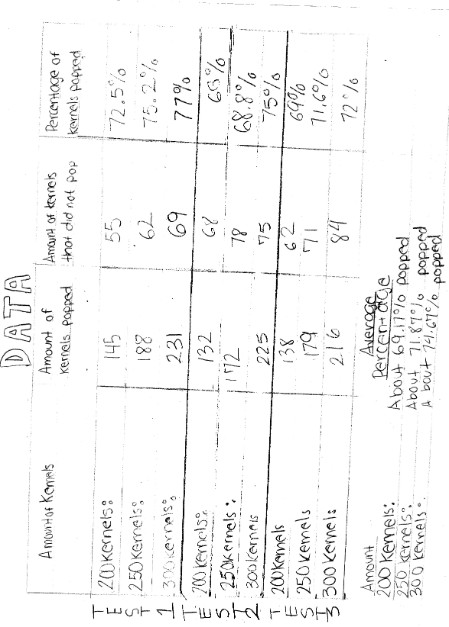
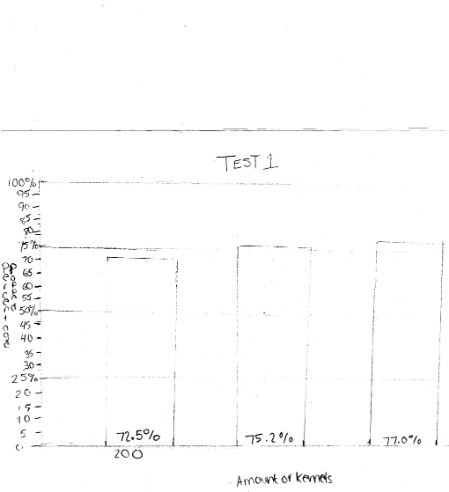
Problem: How does the amount of kernels in a container affect the percentage of kernels popped in a given amount of time?
Hypothesis: If we test different amounts of popcorn in a container, then the containers holding more popcorn will have a higher percentage of kernels popped. That is because the heat will not have much space to escape due to the high amount of kernels in a limited space.
Variables:
Independent:
-Amount of kernels in the container.
Dependent:
-Amount of kernels that will pop in the container.
Constants:
-Amount of time the kernels will remain in the microwave.
-The type of container.
Control: A regular bag of popcorn in the microwave for the same amount of time.
Materials:
-Quart sized Milk Carton
- White Rose 2lb bag of yellow popcorn kernels
- Working Microwave
- Ample workspace and patience.
Procedure:
1. Count each amount of popcorn kernels :
a. 200 kernels of popcorn.
b. 250 kernels of popcorn.
c. 300 kernels of popcorn.
2. Put 200 kernels in a quart sized milk carton.
3. Close the carton and cook in the microwave for 3 minutes and 45 seconds.
4. Count amount of kernels that did not pop and subtract them from the total amount of starting kernels.
5. Repeat process for 250 kernels and 300 kernels.
6. Calculate the percentage of kernels popped in each test.
7. Repeat the experiment 2 more times.
Application: